
Executive Engineering Analysis
When a concrete driveway, patio, or warehouse floor sinks, property owners immediately start looking for the cheapest way to pump it back up. That search inevitably leads to a direct collision between two entirely different technologies: traditional mudjacking and high-density polyurethane injection.
Contractors aggressively debate mudjacking vs polyjacking cost, execution speed, and structural integrity. But if you operate in Massachusetts, the debate is already over. Pumping wet dirt under a heavy concrete slab in a climate defined by brutal freeze-thaw cycles and heavy coastal rain is a guaranteed failure. You need to understand exactly what the difference between mudjacking and polyjacking is, how the equipment functions on the job site, and why injecting heavy slurry guarantees you will be paying for the exact same repair again in twelve months.
- •Adds massive 100 lb/cu.ft deadweight onto already failing native subsoil.
- •Acts as a porous sponge, absorbing groundwater and shattering in winter frost heaves.
- •Requires huge 2" to 3" drill holes that scar and weaken concrete panels.
- •Takes 24 to 48 hours to cure with high washout vulnerability.
- •Ultralight 2 to 3 lb/cu.ft material supports heavy vehicular and industrial traffic.
- •100% closed-cell and hydrophobic; completely repels water and prevents frost heave.
- •Micro 5/8" (penny-sized) injection ports leave slabs structurally intact and clean.
- •Cures to 90% full compressive strength in exactly 15 minutes.
Geotechnical Shear Failure & Void Compression
When heavy cement slurry is injected beneath a compromised slab, the 100 lb/cu.ft deadweight accelerates soil breakdown. Closed-cell polymer lifting eliminates this overburden by sealing sub-surface voids with an ultralight waterproof barrier.
1. Lightweight Foam vs Cement Slurry Mechanics
The core difference between mudjacking and polyjacking comes down to raw material weight and chemical composition. Mudjacking is an archaic process. A contractor mixes a slurry composed of topsoil, aggregate, water, and a small percentage of portland cement. They pump this thick paste into the void beneath your sunken slab.
Polyjacking completely abandons cement. We deploy a closed-cell, two-part structural polyurethane foam. For residential driveways and standard flatwork, we push a 2.0 to 3.0 PCF (pounds per cubic foot) density material. This foam provides extreme compressive strength capable of supporting heavy pickup trucks and daily traffic, but the material itself only weighs 2 to 3 pounds per cubic foot.
For heavy industrial warehouse floors supporting massive forklifts, we push a 4.0 to 8.0 PCF density foam. In both scenarios, you eliminate thousands of pounds of dead slurry weight and replace it with a lightweight, rigid structural polymer block that permanently stabilizes the weak soil without overloading it.
2. The Massachusetts Freeze-Thaw Meat Grinder
The exact reason mudjacking is dead technology in our region is the weather. Massachusetts soil profiles are constantly saturated by coastal rains and heavy snowmelt. Mudjacking slurry is highly porous. It acts like a sponge, actively absorbing groundwater that funnels under your concrete.
When January hits and the temperature drops to ten degrees, the water trapped inside that cement slurry freezes. When water freezes, it expands by roughly nine percent. This creates a massive physical force known as frost heave. The expanding ice aggressively pushes upward against the bottom of your concrete driveway.
Our high-density polyurethane foam is entirely closed-cell and completely hydrophobic. It rejects water. When we inject the chemical, it cures perfectly even in the presence of active standing groundwater. Once hardened, it acts as a permanent moisture barrier. It will never absorb water, it will never freeze, and it completely insulates the concrete from subterranean frost heave. The foam does not wash out, and it does not break down.
3. Drilling Footprint and Structural Integrity
You cannot put material under a slab without drilling holes, but the size of the hole dictates the integrity of the concrete. Mudjacking requires pumping a thick, aggregate-filled paste. To push that paste, contractors must core massive 2-inch or 3-inch holes through your concrete using a heavy drill rig.
They drill these massive ports every few feet. This turns your solid driveway panel into Swiss cheese, severely compromising its structural tensile strength. Afterward, they patch the massive holes with standard grey cement, leaving your driveway covered in permanent, ugly polka dots.
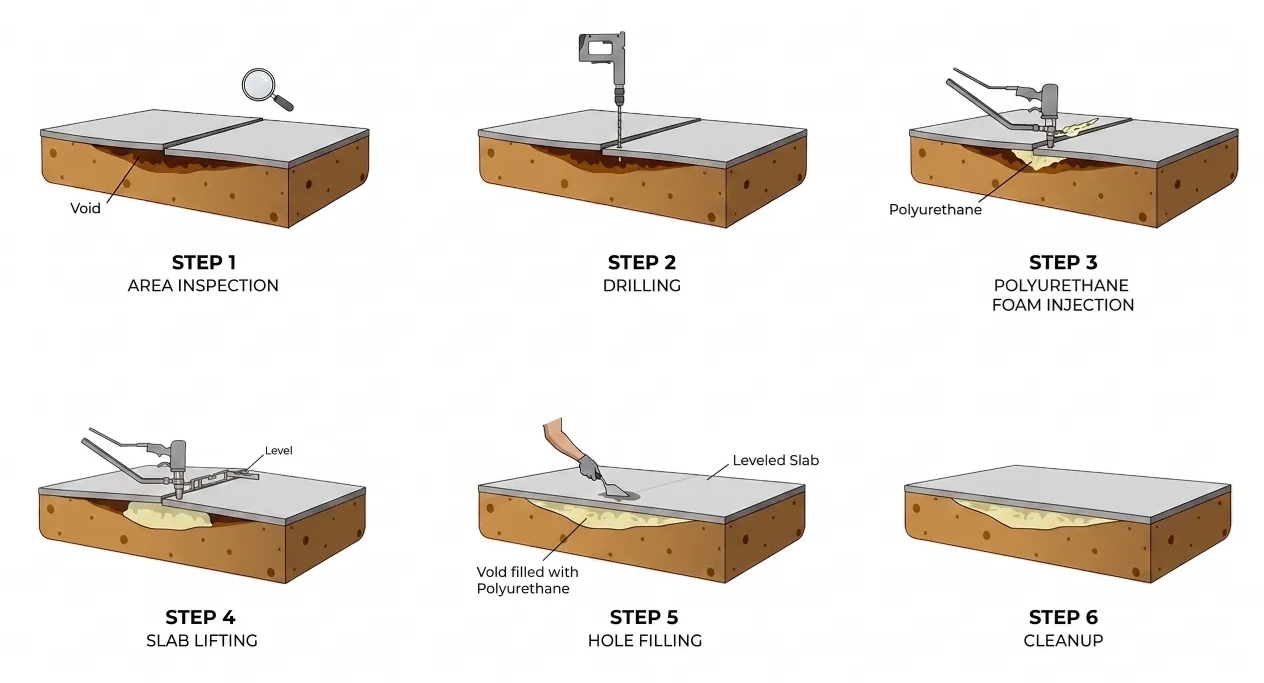
Because polyurethane is pumped as a heated liquid before it expands, our drilling footprint is extremely tight. We drill exact 5/8-inch ports completely through the concrete. A 5/8-inch hole is the exact size of a penny. We drill these ports strategically based on void maps and slab pivot points.
After the drilling is done, we lock mechanical injection packers firmly into the holes. These mechanical packers feature rubber sleeves that expand when torqued, sealing the port and allowing us to inject chemical at massive pressure without blowing material back out. When the lift is done, we pull the packers and seal the penny-sized holes with a high-strength, color-matched cement mix. The repair is virtually invisible.
4. Precision Void Mapping vs. Blind Pumping
Mudjacking contractors routinely show up, drill a hole, stick a nozzle in, and hit the pump until the concrete moves. They have zero idea where the material is actually going. Polyjacking requires exact geotechnical soil assessment. Before we drill a single port, we map the subsurface void. We utilize a dynamic cone penetrometer (DCP) to gauge the exact compaction levels of the soil under the slab.
We find the failure plane. We know immediately if the void is isolated to a two-inch gap directly below the concrete, or if the granular base has entirely washed out down to a depth of three feet.
If the deep soil is loose, we cannot just pump foam at the surface. We drive steel soil injection probes directly into the failing deep strata and pump the chemical at depth. The expanding foam heavily compacts the surrounding dirt, building a rigid vertical pillar from the hardpan straight up to the concrete. We solve the deep soil failure before applying the surface lift. Mudjacking physically cannot perform deep soil injection; the slurry is too thick and heavy to penetrate the strata.
5. Equipment Mechanics and Plural-Component Proportioners
Mudjacking runs off a simple hopper and a mechanical piston pump. Polyjacking requires high-end, highly volatile mechanical processing. We operate a high-pressure, plural-component proportioner rig hard-mounted inside our specialized trailer. The raw chemical arrives in two 55-gallon drums: an A-side (polymeric isocyanate) and a B-side (polyol resin blend).
The proportioner pressurizes the liquid and rapidly heats both chemical lines to an exact mandate of 120-130 degrees Fahrenheit. The liquid is then pushed at 1,000 to 1,500 PSI down a heated hose straight to the injection gun in the operator's hands. Temperature and pressure are the law. If the hose heater drops the temperature, the exothermic chemical reaction stalls. The foam fails to expand, and you end up pumping heavy, unreacted liquid into the dirt, achieving zero lift and wasting material.
At the gun, the A and B sides crash together inside a precision mixing chamber the exact microsecond the trigger is pulled. The liquid shoots down through the mechanical packer. Within seconds, it aggressively expands up to 20 times its original volume, packing every void and compressing the loose dirt. Once the void is completely dense, the foam exerts extreme upward pressure on the concrete. We monitor the lift using digital laser levels, pulsing the gun trigger to bring the slab up in heavily controlled 1/8-inch increments.
6. Failure Analysis: Off-Ratio Spraying & Kinetic Binding
Polyurethane lifting demands ruthless operator oversight. If the Y-strainer on the A-side clogs with crystallized debris, the machine starts pushing more B-side resin than A-side isocyanate. The resulting foam is off-ratio. It comes out soft, spongy, and structurally useless. It will compress the minute a vehicle drives over it.
Our operators constantly watch the digital pressure gauges on the proportioner rig. If the A-side pressure deviates by even 200 PSI from the B-side, the job stops immediately. We bleed the high-pressure lines, tear down the injection gun, clear the intake filters, and rebuild the mixing chamber. We do not shoot bad foam.
Before we inject a single drop, we run a gas-powered concrete saw down the bound joints, clearing the debris and ensuring the slab is completely free-floating. Kinetic relief is mandatory. You must remove the bind before you lift the concrete.
7. Cure Times & Immediate Return to Service
Mudjacking slurry takes 24 to 48 hours to dry. You cannot drive on it, and if it rains before it cures, the wet cement washes out of the void and destroys the job.
Our high-density structural polyurethane foam reaches 90% of its final compressive strength in exactly 15 minutes. The extreme heat generated by the exothermic chemical reaction bakes the foam into a solid structural mass instantly. We pack up the heated hoses, pull the packers, patch the 5/8-inch holes, and you can immediately park a 10,000-pound truck directly on the repaired slab. There is zero operational downtime.
Stop Injecting Mud Under Your Slabs
Get high-density structural polyurethane foam injection that permanently stabilizes soil and repels water.