
Why Concrete Repair Pricing Varies
The concrete repair industry is notorious for hiding prices until a high-pressure salesperson is sitting at your kitchen table. We refuse to operate that way. If you live in Fall River or anywhere across Bristol County and your driveway, patio, or warehouse floor is sinking, you deserve to know exactly what the financial damage is before you make a call.
Concrete leveling costs in Fall River come down to raw chemistry, void volume, subgrade compaction, and equipment overhead. There are two primary methods to lift a sunken slab: traditional mudjacking and high-density structural polyurethane injection (polyjacking). Below is the raw breakdown of square footage costs, hidden variables, and the geotechnical reality of why choosing the cheapest upfront method guarantees you will pay for it twice.
Deep subterranean washouts require more pounds of structural polymer to compact and lift.
Residential slabs utilize 2.0–3.0 PCF foam; industrial warehouse floors require 4.0–8.0 PCF polymer.
Subsurface consolidation beyond 2–4 feet requires probe-driven deep soil stabilization.
1. Mudjacking Cost: $3.00 to $6.00 Per Square Foot
If you call a general masonry or landscaping contractor to lift a sinking driveway, they will likely quote traditional mudjacking. This process has been around for decades. The contractor drills massive 2-inch to 3-inch core holes through your concrete and pumps a liquid dirt, aggregate, and cement slurry underneath the slab to fill the void. The sticker price is attractive: $3.00 to $6.00 per square foot.
Furthermore, cementitious slurry is completely vulnerable to moisture erosion. Fall River gets hit hard by coastal rain, seasonal runoff, and heavy snowmelt. When water funnels under your slab, it hits that wet slurry and dilutes it. The material breaks down, washes out into the water table, and your concrete drops right back to where it started.
You paid $4.00 a square foot for a temporary patch that fails in 12 to 18 months, leaving your concrete scarred with massive patched holes. We refuse to pump mud; we strictly deploy high-density foam.
2. Polyjacking Price: $5.00 to $25.00 Per Square Foot
High-pressure polyurethane injection, widely known as polyjacking, carries a pricing range of $5.00 to $25.00 per square foot in Bristol County. This range exists because you are not simply paying for the surface area of the concrete—you are paying for the exact volume of the unseen void hidden beneath it.
- • Scenario A (1" Drop): A 10x10 slab (100 sq ft) with a 1-inch uniform drop requires a modest amount of structural foam. Cost sits at the bottom of the range ($5–$8/sq.ft).
- • Scenario B (6" Washout): The same 10x10 slab dropped 6 inches due to a broken downspout requires 6x the chemical volume to compact the soil and achieve the lift ($18–$25/sq.ft).
Polyurethane is priced by the pound of raw chemical injected. We provide full transparency on calculated volume estimates before triggering the plural-component proportioner.
3. Material Density Dictates the Project Quote
Not all polyurethane foam is identical. The quote you receive reflects the exact chemical formulation required to support your slab's load requirements:
Designed for standard driveways, walkways, patios, and pool decks. Offers exceptional compressive strength to support heavy passenger vehicles and SUVs while remaining cost-efficient.
Mandated for commercial loading docks, heavy manufacturing plants, and warehouse facilities supporting 10,000+ lb forklifts. Higher raw material cost, but permanently prevents dynamic settlement.
Using a lightweight 2.0 PCF foam under a commercial loading dock will result in re-settlement under dynamic forklift impact. We engineer the exact chemical formulation to the structural load profile.
4. Subgrade Void Mapping & Deep Soil Stabilization
We do not shoot chemical blindly. The price of a project reflects the geotechnical reality of the soil. Before we inject anything, we run a dynamic cone penetrometer (DCP) to measure the exact compaction levels of the dirt beneath your slab and locate the failure plane.
In Fall River neighborhoods like the Highlands or Steep Brook, steep elevation grades drive heavy subterranean soil erosion. The void is rarely just directly beneath the surface slab.
Deep soil injection requires specialized steel probes, higher chemical poundage, and skilled geotechnical labor. This adjusts the quote toward the higher end of the spectrum, but it permanently solves the settlement at its subterranean origin.
5. Plural-Component Equipment & Operating Precision
Polyjacking is not a manual operation run with a wheelbarrow and hand tools. You are paying for industrial mechanical precision. Our operations run on high-pressure, plural-component proportioner rigs hard-mounted inside enclosed mobile trailers.
Raw chemical arrives in 55-gallon drums: A-side (polymeric isocyanate) and B-side (polyol resin blend). The proportioner pressurizes and heats both chemical lines to a strict 120–130°F before pushing the material at 1,000 to 1,500 PSI down heated lines to the injection gun.
If chemical temperatures drop or pressure deviates by 200 PSI, the exothermic reaction stalls, producing soft, off-ratio foam. Our operators continuously monitor digital pressure telemetry, bleed lines, and calibrate mixing chambers to guarantee 100% stoichiometric reaction and structural foam density.
6. The True Cost of Concrete Replacement vs. Leveling
Property owners frequently ask: "Should I just tear the concrete out and pour a new slab?" Let's look directly at the math:
| Metric | Polyjacking | Mudjacking | Full Replacement |
|---|---|---|---|
| Cost / Sq.Ft | $5.00 - $25.00 | $3.00 - $6.00 | $15.00 - $30.00+ |
| Cure & Return Time | 15 Minutes (90% cure) | 24 - 48 Hours | 14 - 28 Days |
| Drill Port Size | 5/8" Penny Size | 2" to 3" Core Hole | Full Demolition |
| Weight Added to Soil | 2 - 3 lbs / cu.ft | ~100 lbs / cu.ft | Heavy Concrete Slabs |
| Addresses Subsoil? | Yes (Compacts voids) | No (Overburdens soil) | No (Pours on bad soil) |
Tearing out concrete costs $15.00 to $30.00+ per square foot once you include heavy demolition machinery, concrete disposal dump fees, new forming, and weeks of curing downtime. Worse, if you pour a new slab on the same uncompacted soil, the new concrete will crack and settle again in three to five years. Polyjacking stabilizes the root cause for 50–70% less cost.
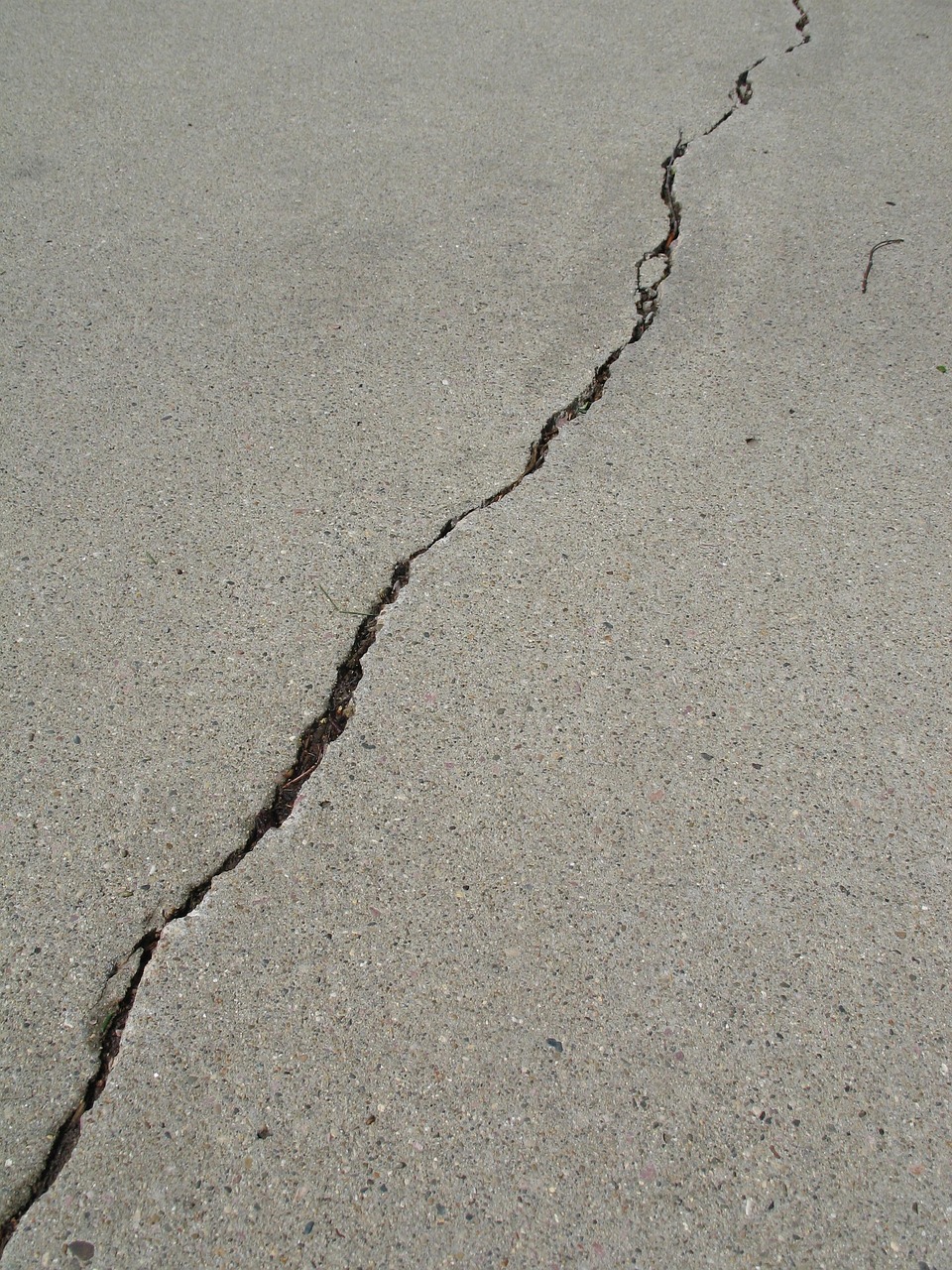
Repair vs. Replacement Economics
Visible concrete shear occurs when sub-slab voids leave panels unsupported. Polyjacking stabilizes the underlying sub-base at a fraction of the $15.00–$30.00/sq.ft cost of full demolition and re-pouring.
7. Kinetic Relief & Expansion Joint Preparation
A final factor included in our transparent quotes is structural preparation. When a slab sinks, expansion joints fill with rocks, dirt, and hardened debris, wedging the sunken slab tightly against the higher adjacent concrete.
Pumping high-pressure foam under a bound slab will build massive subsurface pressure that snaps the concrete across the middle. We mandate kinetic relief: our crews run a gas-powered concrete saw down bound joints to clear debris and allow the slab to float freely before lifting. This critical step protects your concrete from cracking and is factored directly into the transparent job cost.
Get an Exact Price for Your Property
Stop guessing void volumes. Speak directly with our geotechnical lifting team for a precise, honest quote.